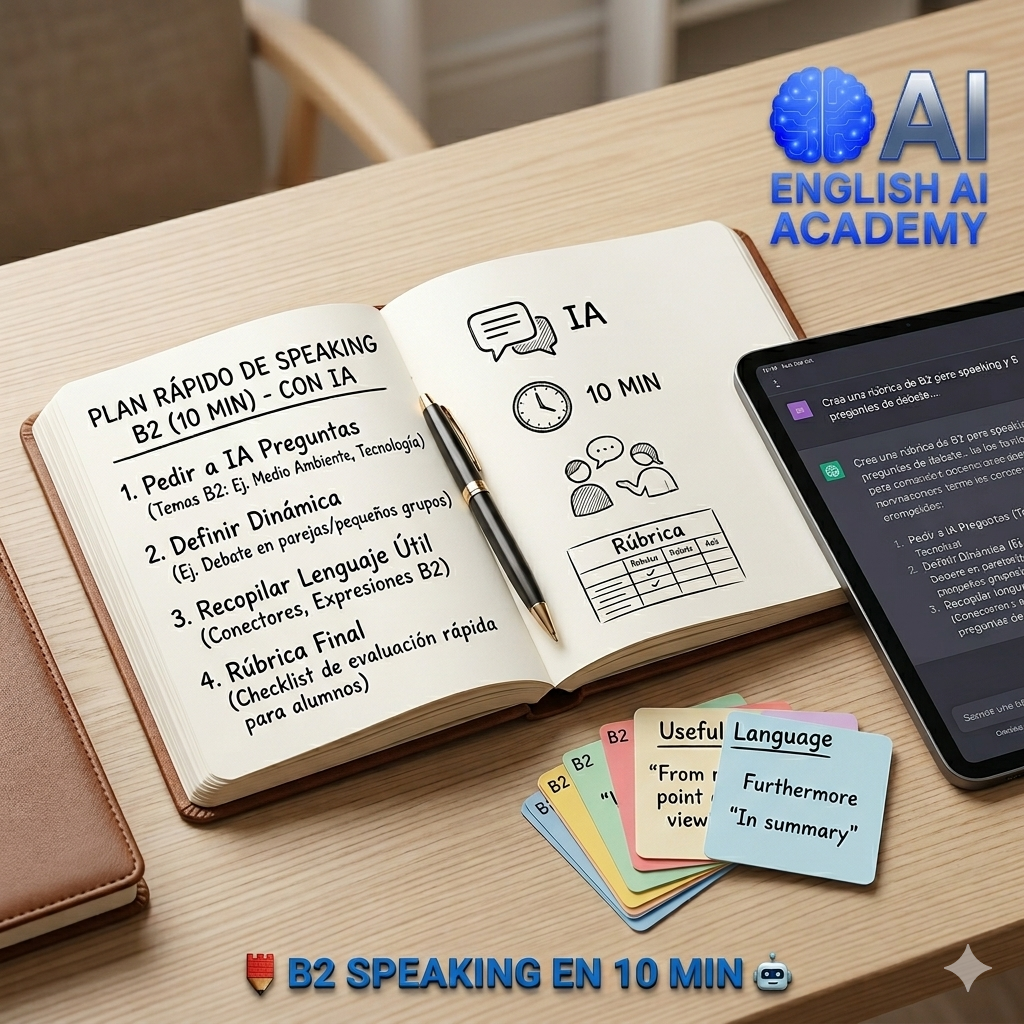
Preparar una buena clase de speaking siempre ha sido una mezcla de intuición, experiencia y… tiempo. Mucho tiempo. Buscar un tema, pensar preguntas, crear una dinámica, añadir vocabulario útil, preparar instrucciones claras… y todo esto después de un día entero de clases.
Pero aquí viene la buena noticia: la IA no viene a sustituirte, sino que viene a devolverte tiempo y cuando aprendes a usarla bien, preparar una clase de speaking en 10 minutos deja de ser un sueño y se convierte en rutina.
Muchos profesores sienten que usar IA es “hacer trampas” o “perder el control pedagógico”. La realidad es justo la contraria.
Tú eres el que tiene todo el control porque la IA no decide por ti, ya que no conoce a tus alumnos y no sabe qué pasó ayer en clase, por ejemplo.
Tú sigues siendo el cerebro pedagógico. La IA solo acelera la parte mecánica para que tú puedas dedicarte a lo importante: escuchar, observar, acompañar, corregir, motivar.
Aquí tienes un sistema simple, repetible y sin tecnicismos. Funciona para cualquier nivel y cualquier tema:
Minutos 1-2
Buscar tema.
Si no tienes un tema claro que quieras trabajar, le puedes pedir a la IA algo así:
“Give me 10 speaking topics for a B for schools class, all related to everyday life, speaking part 1”
Este es el resultado: Daily Routines & School Days, Free Time & Weekends, Technology & Screen Time, Food & Eating Habits, Sports & Staying Active, Family & Home Life, Friends & Socializing, Hobbies & Creative Activities, Celebrations & Special Days, Travel & Transport.
Además de esto, ya te ofrece un par de preguntas por tema para poder empezar.
Minutos 3-4
Pedir preguntas modelo.
Aquí es donde la IA brilla. Escribe un prompt como este:
Como en mi clase de mañana trabajamos el tema de la salud y estilo de vida, le he preguntado esto:
“Create 8 B2 for schools-level speaking questions about health and lifestyle. Part 1 cambridge B2 for schools exam type”
Este es el resultado:
B2 Speaking Part 1: Health & Lifestyle
Minutos 5-6.
- Daily Habits: How do you make sure you have enough energy for a long day at school?
- Physical Activity: Do you prefer playing team sports or doing individual exercise? Why?
- Stress Management: What do you usually do to relax when you are feeling stressed about exams or homework?
- Nutrition: How important is it for teenagers to learn how to cook healthy meals for themselves?
- Sleep: Do you think you get enough sleep during the school week? Why or why not?
- Outdoor Life: How much time do you spend outdoors compared to your parents when they were your age?
- Social Health: Do you think spending time with friends is as important for your health as exercising? Why?
- Future Changes: If you had more free time, what is one thing you would change about your lifestyle to be healthier?
Diseñar la dinámica.
Diseñamos la dinámica apropiada para nuestro grupo y nivel. (Aquí es muy importante el criterio del profesor, que es el que conoce a su grupo de alumnos).
En mi caso, conociendo a mis alumnos y sabiendo que les va la marcha, preparo una actividad de speed dating.
Le pedimos las instrucciones a la IA:
“Write simple classroom instructions for a speaking activity, speaking part 1 for B2 for schools students. Short sentences. Clear steps.”
📢 Classroom Instructions: Speed Dating (A vs B)
Step 1: Form the Lines
- Divide the class: Half are students A, half are students B.
- Sit down: Create two rows of chairs facing each other.
- Pair up: Every student A must have a partner B in front of them.
Step 2: The Rules
- Set A asks their questions first for 1 minute.
- Set B answers, then asks their questions for the next 1 minute.
- Goal: You must keep talking until the bell rings. No Spanish allowed!
Step 3: The Rotation
- The Bell: When you hear the signal, stop talking.
- Move: Students A stay seated. Students B, stand up and move one seat to the right.
- Loop: The student at the end of the row moves to the very beginning.
Minutos 7 y 8.
Lenguaje y expresiones útiles.
Aquí es donde damos apoyo a nuestros alumnos (scaffolding)
Le pedimos a la IA esto:
“Give me 12 useful expressions for B2 for schools students to talk about health and lifestyle with questions of speaking part 1 of the Cambridge exam”.
El resultado que me da son las expresiones, su significado y un ejemplo.
🥗 Health & Diet
- To cut down on [something]: Reducir el consumo de algo.
- Ex: “I’m trying to cut down on sugary drinks because I want to have more energy.”
- To be in good/bad shape: Estar en buena/mala forma física.
- Ex: “I play football twice a week to ensure I stay in good shape.”
- A balanced diet: Una dieta equilibrada.
- Ex: “In my opinion, having a balanced diet is much more important than just doing exercise.”
- To grab a bite to eat: Comer algo rápido.
- Ex: “After school, I usually grab a bite to eat before heading to my basketball practice.”
🏃♂️ Physical Activity & Lifestyle
- To take up [a hobby/sport]: Empezar a hacer una actividad nueva.
- Ex: “I’ve recently taken up swimming to help me relax after a long day of studying.”
- To keep fit: Mantenerse en forma.
- Ex: “Most of my friends go to the gym to keep fit, but I prefer cycling.”
- To be full of energy: Estar lleno de energía.
- Ex: “If I have a healthy breakfast, I feel full of energy throughout the morning.”
- To lead a sedentary lifestyle: Llevar una vida sedentaria (expresión muy B2).
- Ex: “Many teenagers lead a sedentary lifestyle because they spend too much time on their consoles.”
🧠 Mental Well-being & Habits
- To recharge one’s batteries: Recargar las pilas / descansar.
- Ex: “Going for a walk in the park helps me recharge my batteries after my exams.”
- To get enough sleep: Dormir lo suficiente.
- Ex: “It’s hard to get enough sleep when you have a lot of homework to finish.”
- To cope with stress: Lidiar con/gestionar el estrés.
- Ex: “Listening to music is the best way for me to cope with stress.”
- To make a conscious effort: Hacer un esfuerzo consciente.
- Ex: “I’m making a conscious effort to spend less time on social media before bed.”
Minutos 9 y 10.
Rúbrica de evaluación.
Preparar una rúbrica para que los propios alumnos evalúen sus actuaciones.
Aquí puedes elegir (una vez más, el criterio del profesor manda) dónde quieres poner el foco. Si lo quieres en gramática y vocabulario, en pronunciación, en discourse management, etc.
“give me a rubric for students to assess their peers on this activity”
1. Grammar & Vocabulary
What you listen for: correct grammar, good vocabulary, ability to explain ideas.
| Level | What it sounds like |
| 5 – Excellent | Used a lot of good vocabulary and grammar. Only small mistakes. Easy to understand. |
| 4 – Good | Mostly correct grammar and vocabulary. Some mistakes but nothing serious. |
| 3 – OK | Simple vocabulary and grammar. Some mistakes that caused hesitation. |
| 2 – Needs work | Many mistakes. Very basic vocabulary. Hard to express ideas. |
| 1 – Difficult | Very limited language. Hard to understand. |
2. Discourse Management
What you listen for: ability to extend answers, organise ideas, avoid one‑word responses.
| Level | What it sounds like |
| 5 – Excellent | Gave full, clear answers with details. Used linking words naturally. |
| 4 – Good | Gave good answers with some detail. A few pauses. |
| 3 – OK | Answers were short but relevant. Not much detail. |
| 2 – Needs work | Very short answers. Hard to follow. |
| 1 – Difficult | Only one‑word answers or incomplete ideas. |
3. Pronunciation
What you listen for: clarity, stress, rhythm, understandable speech.
| Level | What it sounds like |
| 5 – Excellent | Very clear and natural. Easy to understand all the time. |
| 4 – Good | Mostly clear. A few sounds or words were difficult. |
| 3 – OK | Understandable but with noticeable pronunciation issues. |
| 2 – Needs work | Hard to understand at times. Many unclear words. |
| 1 – Difficult | Very difficult to understand. |
Y en diez minutos (más o menos) tienes una actividad de speaking lista para llevar a clase y poner a tus alumnos a hablar.
El profesor mantiene el control pedagógico.
- Tú decides el objetivo lingüístico.
- Tú eliges el nivel de dificultad.
- Tú ajustas el tiempo y la dinámica.
- La IA solo acelera el proceso. Te hace ganar tiempo.
En diez minutos hemos hecho todo esto:
- Tema.
- Preguntas.
- Dinámica.
- Vocabulario útil.
- Mini rúbrica de observación.
Errores comunes al usar IA:
- Pedir cosas demasiado generales.
- No especificar nivel.
- No revisar el output.
- No adaptar el resultado a la realidad del grupo.
El beneficio emocional: menos estrés, más creatividad
- Menos carga mental.
- Más energía para la interacción real.
- Más tiempo para observar, escuchar y acompañar.
- Más variedad sin agotamiento.
Como podéis ver en el ejemplo, la IA no sustituye al profesor, sino que lo amplifica. Acelera procesos y deja más tiempo para dedicar a acompañar a los alumnos. En la actividad de speed dating se ha visto cómo las decisiones más importantes las toma el profesor: elegir el tema, la dinámica o el vocabulario a usar en la actividad.
Si en nuestro día a día vamos preparando un banco de actividades que sean adaptables a todos los niveles y circunstancias, entonces la IA nos genera un tesoro para ahorrar mucho tiempo.
¿Quieres que te enseñe más actividades como esta? Escríbeme y te enseño más.